Practical Summary of the Diagnostic Aspects of von Willebrand Disease
Background of VWD and it’s types
The von Willebrand disease (VWD) is a bleeding disorder caused by deficiency of and/or dysfunctional von Willebrand factor (VWF). VWD is usually inherited, but acquired forms exist. VWF is a large multimeric protein with several important functions in hemostasis. In the primary hemostasis VWF is responsible for the flow-dependent tethering of platelets to the vascular injury sites. This is done by binding to receptor molecules on the platelet surface and by adhesion to subendothelial collagen. VWF are also involved in bridging to other platelets via aggregation to secure platelet plug formation and primary hemostasis. VWF is also a carrier protein for coagulation factor VIII (FVIII), which is thereby protected from degradation in plasma. VWF can also interact with fibrinogen and fibrin and can thereby contribute to the clot formation process.
VWD is characterized by prolonged and reoccurring mucocutanous bleeds, e.g., epistaxis and menorrhagia, bleeding after tooth extraction or surgery, and bleeding after minor wounds. Typically, the bleeding symptoms originate from several sites. Joint bleeds and frequent gastrointestinal bleeds occur in the most severe cases. To evaluate the bleeding symptoms, it is recommended to use a score-based questionnaire, known as a bleeding assessment tool (BAT). Patients with suspected VWD should be referred to a hematologist or a specialist working at the unit of coagulation disorders to order the relevant laboratory tests and management accordingly.
Congenital VWD is divided into type 1, characterized by quantitative deficiency of VWF, type 2, by dysfunctional VWF and type 3, by lack of VWF. Type 2 is further subdivided into subtypes 2A, 2B, 2M and 2N, depending on the type of functional deficit in the VWF protein. Briefly, the different VWD subtypes can be characterized as follows:
Type 1, partial quantitative deficiency of both VWF antigen and activities. A distinct variant, denoted 1C or type 1 Vincenza, is characterized by very low levels and is caused by markedly increased VWF clearance.
Type 2, can involve several different qualitative defects of VWF which can be further subtyped into:
2A, decreased VWF-dependent (GPIb) platelet adhesion with deficiency of high molecular weight multimers.
2B, increased affinity for platelet GPIb molecule and deficiency of high molecular weight multimers.
2M, decreased VWF-dependent platelet adhesion and/or decreased collagen-binding capacity without a selective deficiency of high molecular weight multimers.
2N, markedly decreased affinity for FVIII (differential diagnosis to mild hemophilia A).
Type 3 is characterized by virtually complete deficiency of VWF.
Diagnostic criteria of VWD
The diagnosis of VWD is based on three main criteria:
The patient should have significant bleeding symptoms,
There should be a family history of appropriately diagnosed VWD or significant bleeding symptoms, except in recessively inherited subtypes, and
VWF levels should be significantly and repeatedly decreased.
The NHC recommendations do not support the idea of a generalized broadening of the classification of VWD, that is, applying a higher diagnostic cut-off level of VWF than 35 IU/dL. However, the assessment of VWD diagnosis must be individual and consider several aspects that may affect VWF levels in any given clinical situation (e.g., acute phase reaction, AB0, pregnancy, bleeding, trauma, etc.). It is also important to point out that laboratory results are confirmed in at least one independent sampling.
Laboratory tests
An initial hemostasis screen will usually result in a normal prothrombin time (PT) and activated partial thromboplastin time (APTT). However, APTT can be prolonged in cases where FVIII:C levels are below 30-40 IU/dL. Measuring FVIII:C level is important as a prerequisite to approach the subtype 2N diagnosis. Additionally, FVIII plays an important role in assessment of the bleeding and likely thrombosis risks in VWD. FVIII:C is particularly low (< 5 IU/dL) in VWD type 3.
As VWD is a heterogeneous disease, its classification requires an extensive laboratory test panel. Specific tests (and recommended abbreviations) for VWD diagnosis and subtyping are:
VWF antigen (VWF:Ag)
FVIII activity (FVIII:C)
Platelet-dependent VWF activity (VWF:GPIbR or VWF:GPIbM)
Collagen binding VWF activity (VWF:CB)
FVIII binding VWF activity (VWF:FVIIIB)
Ristocetin-induced platelet aggregation (VWF:RIPA)
VWF multimer analysis (VWF:Multimers)
Genetic testing of VWF mutations
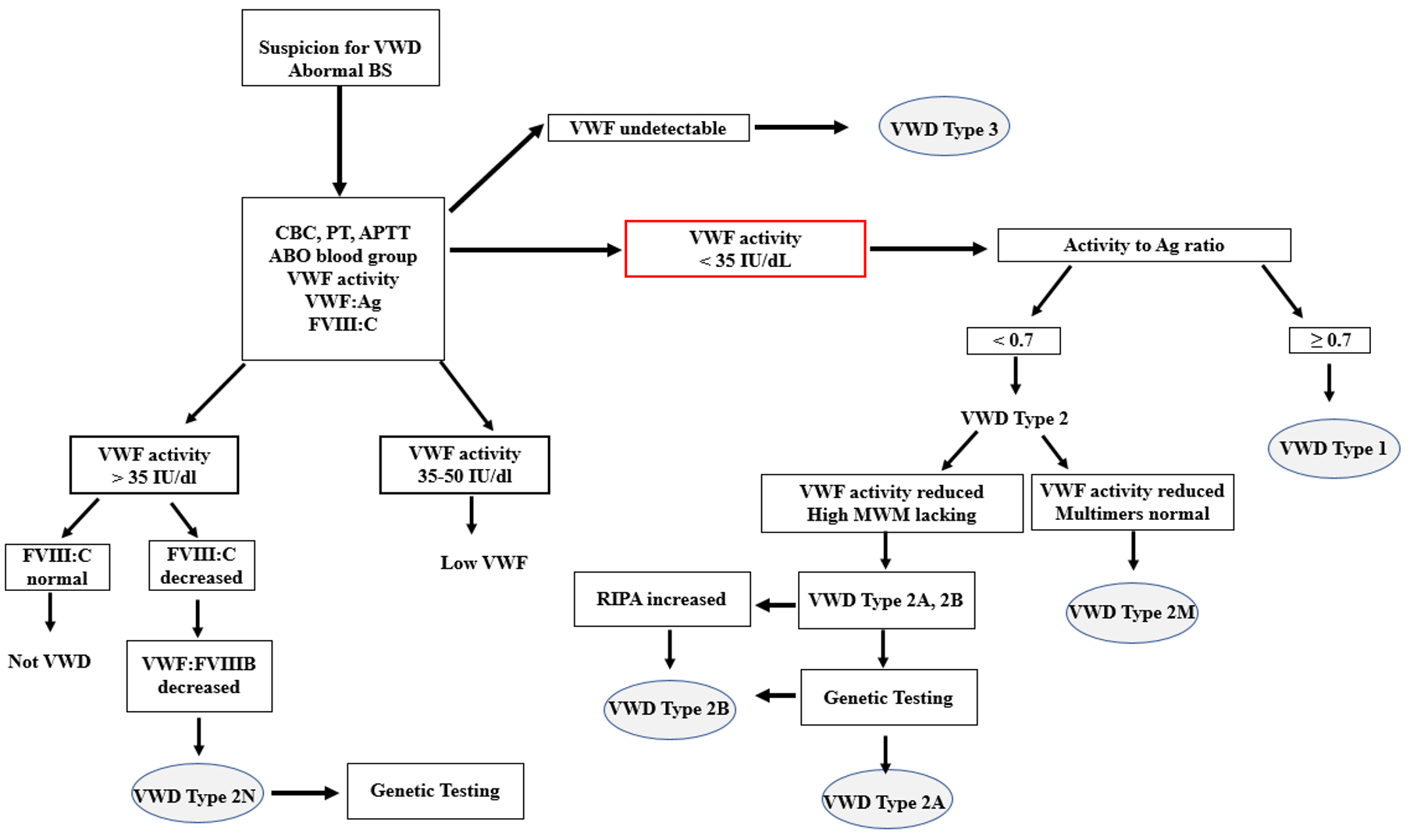
The laboratory examination begins with a hemostasis screen and if VWD can be suspected the initial specific tests involves FVIII activity, VWF antigen and VWF activity levels (VVWF:GPIbR or VWF:GPIbM and VWF:CB). Depending on the results of these tests, additional tests may be used to confirm the VWD diagnosis. A recommended test algorithm for investigating suspected VWD and subtyping can be described with the following figure: